
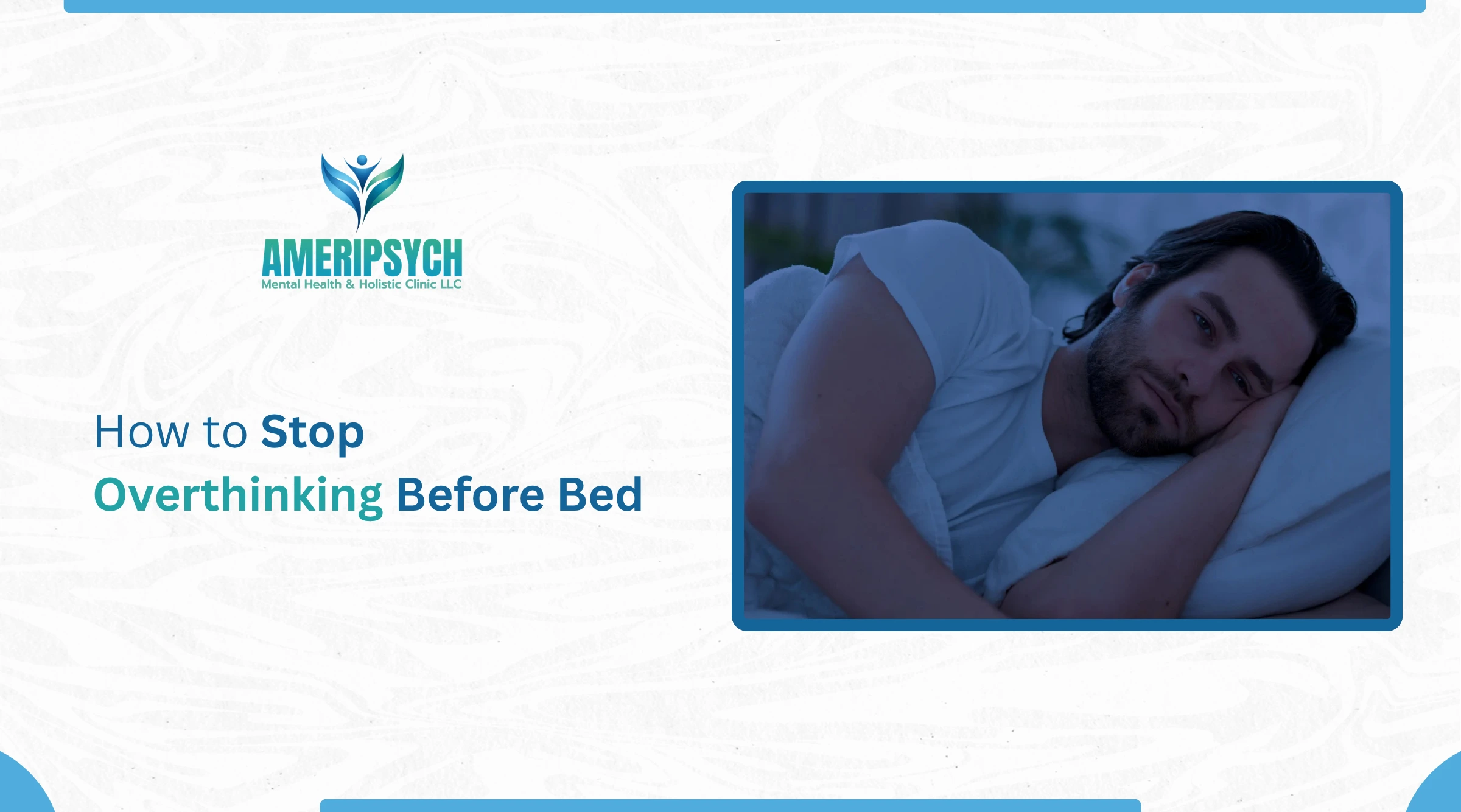
It’s late. You’re tired. You know you need sleep. And yet your brain has decided right now is the perfect time to replay a conversation from two days ago, plan next week’s schedule, and worry about something that may never happen. This post is for that.
Most people who struggle with nighttime overthinking already know what they’re doing.
They lie there watching the minutes tick by, fully aware that thinking about it more isn’t helping.
The problem isn’t insight. It’s that awareness alone doesn’t make the thoughts stop.
So this post isn’t going to tell you to just relax, or think positive, or download a meditation app. Those things have their place.
But if they worked for you on their own, you wouldn’t be reading this. Instead, let’s start with why this happens in the first place, and then get into what actually moves the needle.
Why Your Brain Does This at Night Specifically
It’s not a coincidence that your thoughts get louder the moment you try to sleep. There’s a real reason for it, and understanding it makes it slightly less maddening.
Daytime is full of noise. Nighttime isn’t.
During the day, your brain has a lot to manage:
- Work
- People
- Decisions
- Screens
- Conversations
All of that external stimulation competes for your attention, and it wins. The thoughts are still there, but they get drowned out by whatever’s in front of you.
Then you get into bed. The distractions disappear. The room goes quiet. And everything you’ve been too busy to process during the day finally gets its turn. Your brain didn’t suddenly generate more problems. It’s just that there’s nothing left to drown them out.
What nighttime overthinking actually looks like
It manifests itself in various ways among different individuals but the most prevalent patterns are:
- Running the playback on the conversations or situations, or particular moments, of the day, or weeks, months, even years past, seeing what you should have done, or said, otherwise.
- Anticipatory anxiety, the ruminating through of the future, usually in worst case, usually regarding the things you cannot change at the moment.
- A to-do in the mind, which continues to grow as you attempt to resolve them in your mind.
- Physical agitation and even the thoughts, such as the heart racing, the muscles tending to be tensed, or just simply not being able to settle down.
What Doesn’t Work (and Why People Continue to Do It anyway)
It is better to be truthful with what will not assist before coming to what can assist.
Browsing your cell phone till you feel like going to sleep
This is the most widespread one and it is also intuitively correc.
The issue is that screens cause a type of distraction. They fill your eyes without processing anything, therefore, the thoughts do not go away.
They just pause. And when you lay the phone down, they are still there.
Phone light also inhibits melatonin, which is the hormone that your body uses to inform you that it is time to go to sleep.
It is not merely the postponement of the thoughts. You are making it difficult upon yourself to relax.
Trying to force yourself to stop thinking
This backfires almost in all instances. It has a famous psychological phenomenon that the harder you do not think about something the more it becomes. This is occasionally known as the white bear problem: once someone tells you that you must not think about a white bear, then that is now all you can think about.
You can say to yourself to stop thinking but that does not bring silence. It puts on a second layer of noise, the attempt to stop, on the thought beneath it. So now you are thinking how you have to stop thinking. Not helpful.
At night you are not trying to empty your mind. It is to have less to keep your mind going.
What Actually Helps
These aren’t hacks or quick fixes. They’re things that work because they address what’s actually happening, not just the surface symptom.
Give your thoughts somewhere to go
One of the most consistently effective things for nighttime overthinking is writing. Not journaling in any elaborate sense. Just putting things down on paper before you get into bed.
The brain keeps cycling through unresolved things because it doesn’t trust that they’ll be remembered.
Writing them down is a signal that they’ve been captured. You’re not forgetting them.
You’re just parking them somewhere outside your head so they don’t have to run in the background all night.
This works especially well with to-do lists.
The act of offloading what’s pending seems to quiet the planning part of the brain.
A few things worth writing out before sleep:
- What’s on your mind that you’re afraid of forgetting
- Anything that feels unresolved from the day, even if you can’t fix it tonight
- What you actually need to do tomorrow, in as specific terms as possible
- One or two things that went okay today, not to force positivity, just to give your brain something else to land on
Schedule a worry window earlier in the day
This sounds strange but it works. Set aside 15 to 20 minutes in the afternoon or early evening, not close to bedtime, as a deliberate time to worry.
When a worry comes up during the day, you note it and tell yourself you’ll deal with it during your window. When the window arrives, you actually sit with those thoughts on purpose.
What this does is train your brain to delay worry rather than suppress it.
You’re not telling it the thoughts don’t matter. You’re telling it there’s a time for them, and that time isn’t 11 p.m. Over time, the brain starts to respect that boundary.
The thoughts still show up at night, but they’re easier to redirect because you’ve already given them their moment.
Change what your body is doing, not just what you’re thinking
Overthinking at night isn’t just a thought problem. It’s a nervous system problem. When your brain is anxious, your body responds: your heart rate goes up a little, your muscles tighten slightly, your breathing gets shallower.
Trying to fix it purely through thinking is working against yourself.
A few things that work at the body level:
- Slow, extended exhales. Breathing in more than breathing out activates the part of your body that is in charge of calm and that is the parasympathetic nervous system.
- An hour before bed, a warm shower or a bath. The resulting reduction in body temperature resembles the natural decrease in body temperature that acts as a signal of sleep.
- Gradual contraction of muscles. Beginning with your feet and moving upwards, contract each muscle group of your body in a couple of seconds and relax.
- Waking up when you are not asleep. When you are up more than 20 or 30 minutes, get up, do something quietly in light and go to bed again when you are really sleepy.
Stop trying to clear your mind. Redirect it instead.
An empty mind isn’t a realistic goal for most people, especially people who tend toward anxiety. A redirected mind is more achievable.
The brain needs something to do. If you take away the worries without giving it anything else, it will find its way back. So give it something low-stakes and absorbing:
- An audiobook at low volume
- A podcast about something you’re curious about but not invested in
- Counting backward from 300 by threes (this one sounds ridiculous but it genuinely requires just enough concentration to crowd out intrusive thoughts)
The goal is to occupy the part of your brain that’s prone to looping with something else, something that doesn’t matter, so sleep has room to arrive.
When Nighttime Overthinking Is Something More
The tips above help most people. But sometimes nighttime overthinking is a symptom of something that needs more direct attention.
Signs that it’s worth talking to someone
- It’s been going on for weeks or months
- It’s affecting your functioning during the day
- The thoughts feel out of proportion
- You’re using alcohol or other substances to fall asleep
- You’re anxious about going to bed
- It’s combined with other things like low mood
What’s often underneath it
It is also a classic sign of depression and it tends to affect sleep in a manner that is not directly linked to mood. It is related to previous experiences or trauma.
All that does not indicate that the above coping strategies are useless.
How AmeriPsych Mental Health & Holistic Clinic Can Help
Anxiety and sleep-related issues are some of the most frequent reasons why people contact AmeriPsych Mental Health and Holistic Clinic.
Blessing Dan-Dukor, PMHNP-BC, collaborates with clients to determine what exactly is behind the pattern, whether it is anxiety, mood, past events, or otherwise, and form a treatment plan based on that particular image.
It could involve treatment or medication or both. It can be a process of addressing the underlying anxiety by solution-oriented or motivational methods.
All care is available virtually, so you can access support from wherever you are in Texas. The first step is a conversation.
ONE LAST THING – Bad nights happen. One rough night doesn’t mean you have a sleep problem. But weeks of lying awake while your brain runs laps is worth taking seriously. You’re allowed to get help for it.