
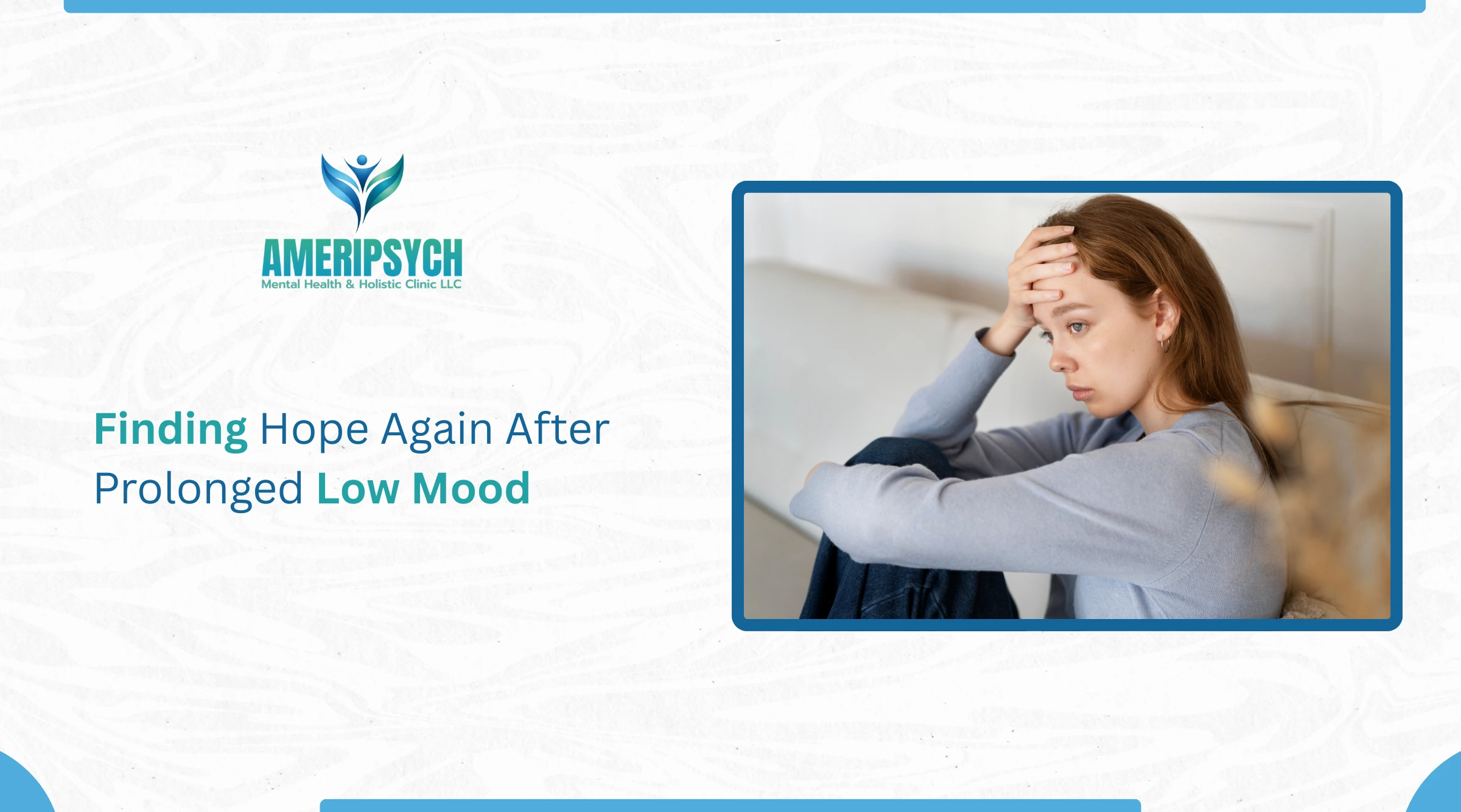
There are days when it seems like a mountain to get out of bed.
What you used to enjoy is a burden or has even lost its purpose.
Life can feel like you are enduring a mundane existence as you are emotionally flat or on autopilot, even leaving you with an out-of-body experience.
Should this be the case with you, then be assured that you are not the only one, and there is still hope.
Low mood is a frequent, poorly understood phenomenon.
Being able to know what is happening in your mind and body is usually the initial stage to improvement.
What Is Prolonged Low Mood, Really?
When low mood persists for more than a few days or weeks, the feeling is more than just sadness.
In clinical settings, it can be linked to persistent depressive disorder (dysthymia), major depressive disorder (MDD), or mood dysregulation in conjunction with other conditions.
Symptoms that one might manifest are:
- Relentless feelings of sadness and hopelessness
- An inability to take pleasure or enjoyment in activities that were once considered delightful
- Low and unrefreshing energy levels
- Memory and thinking related tasks difficulties
- Insufficient and/or excessive sleep and irregular sleep cycles
- Withdrawal from social activities
- Negative self-thoughts that cause one to have an abysmal perspective on their life/self and the future
These signs are not weaknesses or reflective of one’s personality.
They are real changes that take place in the function of your brain – more specifically, how it manages and deals with the regulation of serotonin and dopamine, and the various brain response stress systems, including the HPA axis.
Why Does Low Mood Last So Long?
Why do people feel down and bad for such an extended time period?
Because negative and prolonged feelings create a self-perpetuating cycle.
The less you live life, the fewer chances you are likely to have positive reinforcement. The more you are isolated, the more negative the voices in your head become.
This is the depression that pulls you away from the activities that may contribute positively, and that may uplift and alter your mood.
The Role of Cognitive Patterns
There is a strong link between your mood and your thoughts.
Feelings of depression can include cognitive challenges such as all-or-nothing thinking, where one tends to think in extremes, personalizing situations where one assumes undue responsibility, and catastrophizing, where the mind goes to the worst scenarios.
These thought patterns can feel true and become ingrained in one’s mindset, rather than the low mood being a chronic condition.
The first step to breaking this cognitive pattern is recognizing the need for a change.
It is not merely a matter of thinking positively or wishful thinking – rather it involves working to pinpoint a more precise and accurate thought which is aligned with truth.
This is a central component of cognitive-behavioral interventions which include solution-focused therapy.
What Is Helpful: Evidence-Based Approaches
There will be various degrees of symptoms seen with depression and low moods that tend to last for long periods of time. This is where the research is focused.
- Psychotherapy – This includes CBT & motivational interviewing, whereby you are taught to recognize and avoid negative behavioral patterns, develop practical coping methods, and empathically reconnect with your personal objectives and values.
- Medication Management – In certain individuals, symptoms of moderate to extreme severity, medication to treat an individual with an antidepressant or mood stabilizer can be a highly essential factor in treatment, as it helps in the reestablishment of neurochemical equilibrium in an individual.
- Behavioral Activation – Participating, in the most minimal sense, in something meaningful and purposeful is a way of breaking the cycle of withdrawal and getting back to purpose.
- Sleep and Circadian Regulation – Encouraging sleeping and wakefulness daily and circadian rhythms resolve sleep and mood issues.
- Therapeutic Alliance – Therapeutic relationship has been and remains one of the best predictors of the therapeutic outcome.
The strategies mentioned above are time consuming, and yet, they are effective, particularly when individualized.
Help-Seeking Is an Important Healing Intervention
One feels guilty or ashamed of the fact that one needs help, although it is natural to seek help.
They think, “This is my battle to face” or “It can’t be serious enough if I’m not seeing anyone.“
The harm caused by poor moods that go unattended just accumulates.
With time and space, it can impair your relationship to others, your self-perception, your work, and, in fact, your very identity.
Outreach efforts can be seen as a last-ditch gamble, but in reality it is the total opposite. It is the first step to recovery.
Next Steps
We invite you to AmeriPsych Mental Health & Holistic Clinic, where we pride ourselves on treating the whole person.
We focus on the individual while we work with you to create a plan that incorporates the best evidence based practices with psychotherapy and medication.
Our provider, Blessing Dan-Dukor, PMHNP-BC, will work with you, your history, and your goals to create a plan that works for you.
We accept most major insurance plans and we offer telehealth and in-person visits. We want you to feel like yourself.
Schedule your consultation with us today.
FAQs
What is the difference between prolonged low mood and depression?
Low mood lasting for a prolonged duration can be a symptom of multiple disorders, including persistent depressive disorder or major depressive disorder.
A clinical evaluation assists in pinpointing the diagnosis and treatment options.